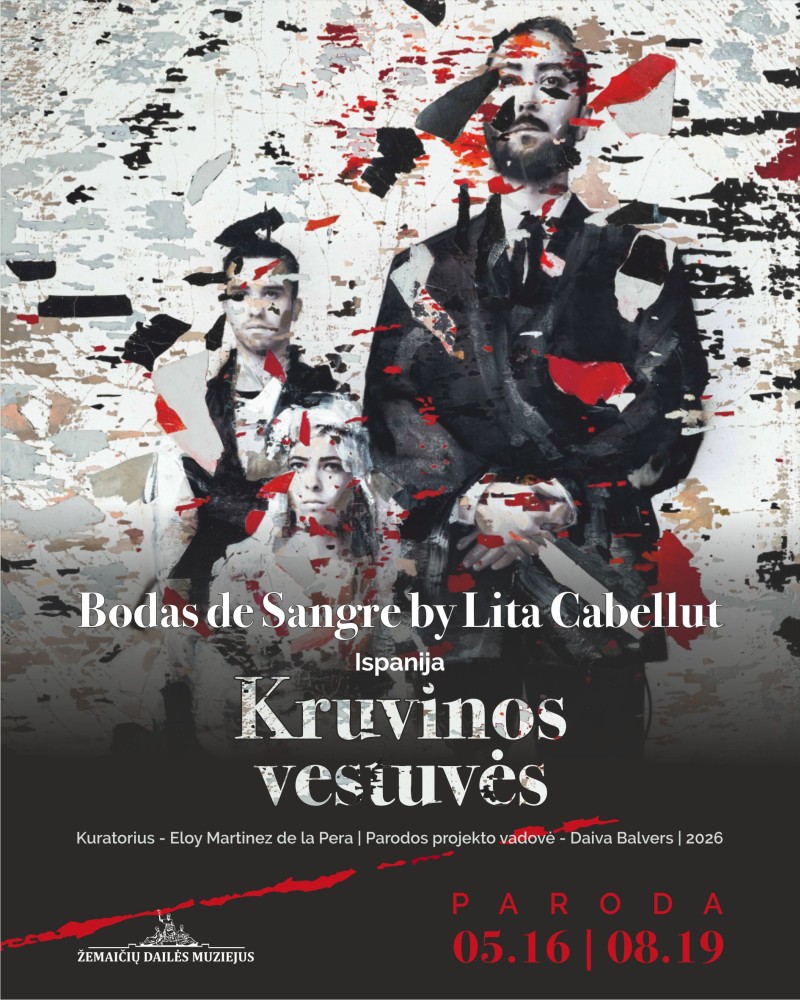
Kruvinos vestuvės x Bodas de Sangre
16-05-2026 | Samogitian Art Museum | Plunge | Lithuania
Life Tearing Through Art & Blood Wedding x Lita Cabellut
Spanish artist Lita Cabellut arrives in Lithuania for the first time with an unprecedented double exhibition unfolding, exceptionally, across two spaces of the Samogitian Museum. With more than four decades of international trajectory and a distinguished career shaped between Spain and the Netherlands, Cabellut presents simultaneously Life Tearing Through Art and, in a truly historic moment, Blood Wedding—revealed to the public for the very first time as a complete project.
Together, these two interwoven bodies of work enter into a powerful dialogue, transforming the museum into a territory of profound reflection, heightened emotion, and uncompromising contemporary commitment.
The main building of the Samogitian Museum hosts Life Tearing Through Art, a journey through the fundamental pillars of her work, featuring 35 pieces rigorously selected by curator Eloy Martínez de la Pera. The exhibition spans different stages of her career, delving into the depths and contradictions of the human soul, and offering a comprehensive and cohesive reading of her creative universe.
In the extensive annex to the palace, the former royal stables, Blood Wedding is presented as Cabellut’s personal interpretation of the celebrated play by Federico García Lorca. Through 27 works and a striking scenographic installation, visitors move through Lorca’s dramaturgy from a contemporary perspective that connects the tragic passions of the text with the social and moral concerns of our present time.
Samogitian Museum: Life Tearing Through Art: five pillars, one dialogue
This first exhibition proposes understanding Cabellut’s oeuvre as a living body, sustained by ideas that run throughout her entire production. Rather than a conventional retrospective, the project offers a conceptual reading that reveals the profound coherence of her artistic language. The artist has consolidated a distinctive voice, recognizable for its material strength and psychological intensity, grounded in five conceptual pillars that structure her creation:
LIFE · PASSION · POWER · IDENTITY · FREEDOM
The selection curated by Eloy Martínez de la Pera is organized around these axes, without following a chronological order, in order to highlight the conceptual consistency and enduring relevance of her work. Each piece becomes part of a narrative that transcends the pictorial surface and turns into a space for ethical and emotional reflection.
Life Tearing Through Art reflects a singular trajectory: harsh and delicate, poetic and brutal, reflective and sudden, harmonious and raw… yet always woven through beauty. It is a body of work that surpasses the limits of canvas and color to enter the depths and dichotomies of the human condition.
Through her intense, vulnerable, and challenging gazes, Cabellut invites us to reflect on fragility, passion, solitude, and redemption. Her works function as mirrors in which we recognize our struggles and hopes, immersing us in the tension between good and evil, love and hate, vice and virtue, freedom and determinism, reason and passion.
In this intimate dialogue with the viewer, her painting compels us to pause and contemplate the complexity of life from a renewed perspective—more honest, more uncomfortable, and precisely for that reason, more human.
Samogitian Museum Stables: Blood Wedding by Lita Cabellut.
If the main building offers a journey through the artist’s conceptual universe, the former royal stables immerse visitors in an experience charged with dramatic intensity. Blood Wedding x Lita Cabellut presents a powerful visual reinterpretation of one of the foundational texts of 20th-century dramaturgy.
Far from providing a literal illustration of Lorca’s play, Cabellut delves into its emotional and symbolic essence. Her proposal is rooted in a radical conception of love: love for language, for truth, for identity, and for the human condition. Through painting of great expressive force and psychological depth, she establishes a direct dialogue between Lorca’s tragedy and the tensions of our contemporary world.
The exhibition addresses issues of urgent relevance, including women’s equality, the construction of identity, and the critical reassessment of inherited roles. The exhibition path also reflects on distrust, resentment, fear of loss and death, and the ethical fragility of a society shaped by overexposure and artifice.
Within this context, Cabellut’s work emerges as a contemporary mirror—an invitation to introspection and to both individual and collective questioning. A body of work that does not offer closed answers but rather proposes an intense and transformative experience.
Together, these two exhibitions mark a defining moment in Lita Cabellut’s international trajectory and in the cultural life of Lithuania. They are conceived not merely as displays of artworks, but as immersive experiences—spaces where painting, architecture, and dramaturgy converge to create an encounter that lingers long after the visit has ended.
For the very first time, Blood Wedding is presented in its entirety, allowing audiences to experience the full emotional and conceptual scope of Cabellut’s interpretation of Lorca’s masterpiece. Installed within a truly exceptional venue—the former royal stables—the exhibition acquires an almost theatrical intensity, where space itself becomes part of the narrative. The scenography amplifies the drama, the silences, and the tensions embedded in the works, transforming the act of viewing into a visceral experience.
Paired with Life Tearing Through Art in the museum’s main building, the project unfolds as a powerful dialogue between past and present, intimacy and monumentality, reflection and confrontation. The exhibition design, bold and meticulously conceived, heightens the material presence of each piece and guides the viewer through a journey that is both emotional and intellectual.
These are exhibitions that will not leave anyone indifferent. They promise to be unforgettable—not only because of the scale and ambition of the project, but because of the depth of feeling and thought they awaken. In bringing together two bodies of work of such intensity, in such extraordinary spaces, the Samogitian Museum offers a rare and transformative encounter with one of the most compelling artistic voices of our time.